Friday, 21 September 2007

Fishing for carp in the summer


Summer is definitely my favourite time of year for catching carp. Night fishing is a real passion of mine and I enjoy nothing more on a summer's night than to be beside the water.

Carp are very active in the summer months and locating them can be easier than in winter.

Carp enjoy the sun as much as we do, and if you spend some time watching the water they will give themselves away.

Before fishing it is a good idea to have a look around the venue, then choose a swim. If you are a regular at a particular water, watch the fish movements and see if you can establish patterns that might give you an idea where to fish in the future.

Consider the natural food that is in abundance at this time of year. The trees are full of friut and nuts, similarly flavoured baits are a good starting point.

Look for obvious feeding grounds, for example, beneath overhanging trees and amongst weed beds.

Summer time is also a good time of year to try out new rigs, baits and ideas of your own.

Always make sure that you have some floating baits in your kit and if possible a spare rod set up to fish them. I have banked many bonus carp while bolt rigging. I certainly would not have caught them if my spare rod had not been ready.


Thursday, 13 September 2007

The Ultimate Secrets Revealed


In 2004 I had a terrible year of carp fishing. I caught far fewer fish in that year than I did in previous years. And, the fish I managed to catch were a good deal smaller than those I caught in prior years. I have thought about this for a long time, and have reached the following conclusions:

1. BETTER EQUIPMENT MEANS FEWER FISH. Yep, it’s true. I’ve replaced my old 6-foot bass rods with 12-foot carp rods. My old spinning reels, which had served me faithfully for years, have been replaced with baitrunners. Instead of cutting a couple of forked sticks from a nearby tree, I no w have a nice rod pod. I could go on, but you get the point: I’ve upgraded to real carp equipment. The carp don’t seem to care.

2. MORE EQUIPMENT MEANS FEWER FISH. There is no doubting the truth of this statement. I have a cart full of equipment. In the past, I didn’t even have a cart. Now I need one to carry everything I’ve bought. In the past, I hopped out of the car and was set up and fishing within ten minutes. Now I can’t even unload the cart in ten minutes; it takes me about forty-five minutes to get set up and begin fishing. I know the carp start laughing when they see me coming down to the bank dragging this arsenal of gear.

3. FANCY BAITS MEAN FEWER FISH. I suspect all of us know the truth of this statement. Now I have to start days in advance to prepare my baits. First there’s the groundbait – I’ve got nine (honestly, nine) separate plastic bins in the garage, each containing a different type of animal feed. Then I have to spend a whole evening grinding this stuff in a blender to reduce it to granules. Then I mix it and bag it. And that’s just my groundbait. After all that, I start making my actual bait - boilies. I’ve got multiple types of flours and other ingredients that go into the dry mix. Then there’s the flavors...I buy these from specialty shops. All told, it takes hours for me to get my baits ready for a weekend of fishing. I think my baits scare the carp! In the past, all I did was stop in at the grocery store on my way to the river to buy a can of corn. I caught a lot of carp; you would think I was exaggerating if I told you how many.

4. SPECIAL RIGS MEAN FEWER FISH. I’m doing it all...hair rigs, safety rigs, anti-tangle rigs, feeders, anti-eject rigs, backleads, shock leaders...the carp must really be having a laugh at my expense. In the past, I side-hooked my corn on just about any hook I had handy. I used to catch so many, I’d literally lose count. Big ones, too.

5. THE MORE KNOWLEDGE YOU ACCUMULATE, THE FEWER FISH YOU CATCH. This is completely true and cannot be refuted. I’ve gotten tons of advice from the CAG discussion forum, from books, from videos, from going to fish-ins, and from weekend trips with other carp anglers. None of it works. Period. Forget about the barometer, the temperature, the phase of the moon, the time of day...it’s all useless. The simple truth is, sometimes the fish bite, and sometimes they don't. In the past, my approach was much more successful: if I had the time to go fishing, I went. If I was too busy, I didn’t. It worked.

6. IF YOU TRAVEL TO THE BEST VENUES, YOU WILL CATCH FEWER AND SMALLER FISH. This past year I drove all over the state of Indiana in search of twenty-to-thirty-pound carp. Most of these places are three or more hours from my house. I’ve gone to all the places in the state that have the best reputation. If a lake was rumored to contain monster carp, I got directions to it and off I went. I even traveled a couple of thousand miles to fish in one of the best venues in the country. But you know the largest fish I’ve ever caught came from the river about fifteen minutes from my house. And I caught lots of them there.

7. THE MORE COMFORTABLE YOU ARE WHEN YOU ARE FISHING, THE FEWER FISH YOU WILL CATCH. This is absolutely true, without question. I bought myself a nice brolly to keep me comfortable. These umbrella shelters seemed perfect to me. I had to have one. Too much sun? Set up the brolly. Is it starting to rain? Get out the brolly. What a mistake! In the past, if I was fishing and it got too hot or too rainy, I went home. The reason? The fish would quit biting when it was too hot or too stormy.

8. THE USE OF ELECTRONIC GEAR WILL GUARANTEE YOU CATCH FEWER FISH. There is no doubt about this one. I’ve bought myself a wireless sonar device, with a transducer that you tie to the end of your line. This is great, I thought: a device that will accurately map out the lake or river bottom. I can scope out the water and find all the best holes. I invested a lot of time, specifically making trips to map out the bottom. I found some places that looked perfect. So I started fishing those swims. The only problem was those places had no fish! In the past, I went down to the river and if I could see carp feeding somewhere, I would fish there. And I would catch them. And of course there are other electronics, like my bite alarms. Do you know what these alarms do? They certainly don’t attract carp – they attract other anglers, who come over to fish right next to me when they hear one go off.

So there you have it – I have invested lots of money, spent countless hours, drove thousands of miles, and gathered all kinds of information. The grand result that I have achieved is that I catch far fewer and much smaller fish than I ever have. Even my wife comments on this. “Gee, you don’t seem to be catching many fish anymore,” she said the other day. “You used to do real well down at the river over near the bridge. Why did you stop going there?” I mumbled something about the cycles of nature and went out into the garage to find my old 6-foot spinning rod. "Honey," I said, "do you have an extra can of corn?"

Now it’s probably worth saying that everything I’ve written here is only a half-truth, a tongue-in-cheek tale meant to try to console myself after a poor year of catching. Of course, all gear has a place, and I love using my distance rods and the associated tackle as much as I love sitting on the bank with a can of sweet corn and my old bass gear. In fact, truth be known, I rarely do the latter any more. But the memories of my very first carp, caught with nothing more than some old gear that I had laying around in the garage, are among the sweetest carp fishing memories of all.

Bolt Rig Basics - Inline Rig

Well what with winter etc. curtailing some of my expeditions I've decided to fill some time by posting some basic rigs ( now I've sussed out Photoshop ) used by us Euro ( sic ) guys. Now this is strictly an introduction - there are always different ways to skin a cat which you can find out from others. This is the Janet and John stuff

Starting with one of the most widely used set-ups, the Bolt Rig.

The principle is simple ( see below. )

In Step 1, the fish picks up your hookbait on a slack leader, taking with it the hook..

In Step 2, as the carp moves away the leader tightens and the weight of the lead comes into play. The carp 'bolts' ( hence the name ) and the weight of the lead helps pull the hook home.

Right, here's how to construct a simple in-line bolt rig.

First you need your components.

OK this is what I'm using here ( ps this just my own personal preferences - obviously there are other makes and types etc. ) My rig here consists of 8" Kryston Snakebite leader with a size 8 Fox Uni-swivel to a size 8 CarpRus Longshank hook tied with a hair rig. 3oz Fox inline lead, tail rubber and 12" sink tubing ( your tubing must always be longer than your leader, about 1.5 times the length is ideal. )

Step 1: Thread your mainline through the tubing and then thread on the tail rubber, which must slip over the end of the tubing.


Step 2: Thread on your weight, attaching it to the tail rubber.


Step 3: Take your leader swivel and push it into the rubber or plastic housing. This is an essential move, since this housing creates the 'semi - fixed rig' set-up essential to a bolt rig. IT MUST NOT be jammed in too tightly so that if the line breaks or the lead gets snagged up the swivel can be pulled free of the lead. At the same time if the swivel can come free too easily when the carp picks up the hookbait the bolt rig effect is lost as the weight of the lead will not come into play.


Step 4: Push the housing into the lead weight and there you have it.


Just want to re-iterate the 'semi - fixed rig' thing. The important thing here is that the weight is fixed to the leader so the weight helps drive the hook home. But it is important that the swivel can come free under pressure. If, for example, a mainline break occurs it is important that the leader can come free of the weight so that it is not going to have to drag around a length of line attached to a lead weight. This will often eventualy kill the fish, why such fixed rigs ( for example, tying the lead weight to a mainline ) are known as 'death rigs'. Its important to get a balance whereby the swivel is fixed enough to the weight to allow the 'bolt rig' efect and loose enough to pull free in an emergency.

Boilie Recipes

2 egg mix

This recipe is simple and had a good bite response on it’s very first outing including a 22 pounder from the Chicago River. I use the small 13 ounce coffee can and the measurements don’t have to be exact.
- 1/2 coffee can of cooked feed corn that has been ground in a food processor*
- 1/2 coffee can of Frosted Oat Cereal that has been powdered in a food processor
- 1/6 coffee can of semolina flour
- 2 eggs
- enough water or milk to make paste (1 or 2 tablespoons)
- 4 tablespoons of canola oil

Mix all ingredients together to make a thick paste, but solid enough to handle. Let the dough ball rest for around 10 to 15 minutes. Add a little more moisture if you need it. If dough is too wet add the flour - cornmeal mixture to stiffen it up. Roll into sausages and then into balls and boil for around 4 minutes. Spray over with flavor and dry over night or prepare flavor bath (small amount of flavor, sweetener, and color with enough water to cover the baits) and soak over night.
* Be careful with the food processor, already burned up one.

Birdseed Boilie Mix

This has also caught on the river. I tipped the boilie with corn and popped it up. It actually is like a particle boilie and it had a lot action even on the first outing.
- 1/2 coffee can* of cooked feed corn ground in a food processor
- 1/2 coffee can of Frosted Oat Puffs ground in a food processor
- 1/4 coffee can of birdseed Ground to a flour
- 1/2 cup of powdered milk
- 1/6 coffee can of semolina flour
- 2 eggs
- enough water or milk to make a paste (1 or 2 tablespoons)
- 4 tablespoons of canola oil

Mix all ingredients together to make a thick paste, but solid enough to handle. Let the dough ball rest for around 10 to 15 minutes. Add a little more moisture if you need it. If dough is too wet add the flour to stiffen it up. Roll into sausages and with a boilie roller, roll into balls and boil for around 4 minutes. They may not float when done. Air dry on a screen rack. Spray over with flavor or prepare flavor bath (small amount of flavor, sweetener and color) and soak over night. My favorite flavor bath for this one is: Richworth's aniseed, Hutchinson's intense sweet and yellow food color with enough water to cover the baits. *I use the small, 13 ounce coffee can and my measurements are never exact.

River Boilie Mix

This simple basic recipe works well in rivers or lakes and is simple and easy to make. It is easy to add more or less flavor. I like strawberry or almost any fruti flavor, the flavors can be Koolaide, cake flavors or even specailly made European style carp bait flavors.
Equal parts corn meal, semolina and soy flour
Enough eggs to make it into a dough
Any bait flavor including Koolaide, cake flavors or carp bait flavors, just enough to be able to smell it in the dough
A little artificial sweetner like Equal
A few drops of food coloring
1/4 tablespoon of vegetable oil for each egg

Mix eggs, flavor, sweetner and food coloring. Add premixed flour to make a stiff dough. Let sit for 10 - 15 minutes. Roll into sausages and roll into balls or flatten to about 1/2 inch thick and cut into cubes. Boil for about 1 - 2 minutes depending on how big the balls are, about 2 minutes for 20mm boilies, less for smaller ones. Remember to write down everything in your recipe!! If you catch a BFC you will want to be able to recreate your bait again!!

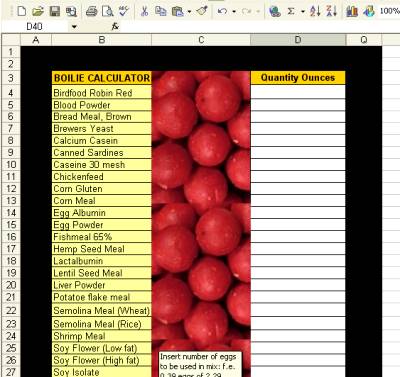
Boilie Calculator (Excel Worksheet)

Boilie Calculator screenshot

Especially for the CAG website, I created a boilie mix composer. With this simple Excel tool, one can easily calculate the composition of a boilie mix in terms of percentages of Carbohydrates, Protein and Fat content. In addition, it’s easy to see what the ultimate hardness of the boilie would be, how easy it is to process the boilie mix and to what extent boilies have a short or long term attractiveness to carp.

Hardness: Scores vary between 25 and 100, with 100 being a very hard boilie that lasts a long time in the water without getting soft

Processing: Scores around 25-50 mean boilies are very difficult to process. The dough may be very sticky, spongy and especially with rolling tables difficult to process. A score of a 100 means you created a boilie makers dream dough composition.

Instant Response: In general, I am assuming that high Carbohydrate boilies lead to a high instant response (with a score between 75 and 100) and would be very useful in short term campaigns without time to pre-bait. High Protein boilies which will score around 50-75, are more useful to be baited up with in the longer run.

So how does it work: Simply fill in the ounces of ingredients that you will be using in the base-mix. There are 30 main boilie ingredients to choose from. For those people who have some specific boilie ingredients they would like to include, please send me a pm or e-mail and I’ll see if I can update the Boilie Calculator.

In addition you have to add the special ingredients such as eggs, sugar, salt, oil, powder additives (f.e. chili powder) and flavors. I used the weight of an “average” egg of 2.29 ounce. Just fill in the number of eggs you will need in your mix in the green cell (in my case I often work with an average of 0.39 eggs per ounce of dry mix, but this will very much depend on the exact composition of the mix). In case you use smaller or bigger eggs, you can manually overwrite the total egg weight in ounces in the blue cell.

And that’s it really. Have a look at it and tell me if you would like something changed. Of course the exact protein/fat/carb content will differ somewhat depending on the supplier and quality of the ingredients. So don’t see it as an exact science. It’s a tool that might give you a better idea of the composition of your boilies, especially for starting boilie makers. Of course you could also apply it for dough balls (with the exception of the “hardness” factor).

If you put the number of eggs at zero, you can also check the composition of any individual ingredient. Let me know if you would happen to disagree with a particular composition. This is still the first version and I’m sure there will be quite a few changes in the future.

Note for the high protein freaks: do you see how difficult it is to get to a very high protein level (f.e. above 60%) if you keep using whole eggs in your boilies? There is simply a too low protein contents in whole eggs. It might be better to start using egg powder and egg albumin instead. Or accept a lower protein contents in the 40-50% ranges (which in my view would be more than enough anyhow).

Have fun!

Carping Basics - Some Necessities

Stuff I never go fishing without ( apart from hooks, weights and bait of course ;o)

A. Binoculars - fish for spotting thereof ( and spying on what other people are up to :)
B. Penknife
C. Good, sharp scissors ( esp. if you use braid )
D. Boilie stops - holds the boilie/bait on the hair rig.
E. Bait needle - for threading baits onto a hair rig.
F. Bait drill - used for making a hole in esp. hard baits ( eg nuts and pellets ) so that they can be put on a hair rig.
G. Superglue. For repairs etc.
H. Gardiner loop tying device - creates perfect small loops on the end of a hair.
I. Forceps - for unhooking fish.
J. Sink tubing - helps prevent tangles and also pins the line down to the bottom so less chance of a fish being spooked by the line.
K. Heat shrink tubing - necesary for many parts of rig creation ( eg boomarms and line aligners )
L. Imitation baits - tougher and bouyant. Shown are imitation corn, maggots and dog biscuit.
M. Rubber bait bands - for attaching small pellets direcrly to a hook.
N. Cork balls - can be used as a bait in their own right, or for moulding paste around.
O. Splicing needle - for threading small baits onto a hair and rig making.
P. Metal putty - for moulding around line to hold down baits and the line itself. More versatile than split shot weights.
Q.Clip swivels - allow you to change rigs and leaders quickly. The leader can just have a loop in one end, which goes into the clip.
R. Float stops - for creating semi-fixed bolt rigs on a running lead setup.
S. Degorgers - for unhooking fish that are deeply hooked.


Hair Rig, Bolt Rig and the Knotless Knot

For 30 plus years I freelined doughballs and swung at twitches...or sat watching the twitches waiting for a good take too swing on...then a few years ago I found the HAIR RIG, thanks to the British, and my whole approach to carping and catch rates changed drastically. Unlike many of my "nice to have", but, "not necessary" Euro items of tackle....this is now a "must" for me..along with baitrunner reels. It can be frustrating when first learning...just like anything else in life....but, with frequent use comes familiarity....and you won't be sorry.

Using a hair rig will greatly increase your catch rate. Carp, for the most part, will usually mouth/taste food first...inhaling it, then quickly exhaling. If they don't like the taste...they won't touch it again. The hair rig will usually catch these finicky eaters on the first taste...especially if coupled with a heavy weight (bolt rig)...which will be covered more later.

The hair rig will also allow you to use harder baits that can't be used on a standard "hook" set up. This has the advantages of being able to cast harder/further and the bait will last longer once cast out. Some of my favorite baits are re-hydrated field corn ($5 for 50 lb bag), chic peas (garbonzo beans), boilies and doughbaits. To use doughbaits on hair rigs...just thread on a small cork or bead on your hair and then you can mold your dough around the cork; thus your hook hook won't be buried in the bait.

Many carpers use a knot to form a loop in the end of their hair. I find this makes too big a hole in the bait you are threading....so I just make the whole hair a loop, as shown in the picture above. Spider Line, 50 lb test is my material of choice for tying hairs...then using a leader material that fits the situation.

To bait a hair, first thread your bait on a baiting needle and hook the hair loop with the needle. The yellow is simulated corn...the red is foam to lift the bait (not the hook) up off the bottom as this will make it more visible and give you better scent attraction in all directions. The foam is not necessary though and could be replaced with another kernel of corn. Another feature of using the foam though is that it can be dipped in a flavor/attractant and further enhance the attractiveness of your bait.

NOTE:You can make a baiting needle by just straightening out a long shanked hook.....slide the bait on the shank...hook the hair's loop with the barb...slide bait onto the hair.

Next...slide your bait from the needle onto the hair.

Then put a hair stop through the loop. I use little plastic bar bells available at craft stores. You can also use a piece of grass or heavy piece of mono line as well. Just something small that will keep the bait from sliding off the loop. Lastly, slide the bait down to the stop. The gap shown between the base of the hook and the bait is about all the bigger you want to have it.

To tie the "hair" itself...view the animated picture below. This is called the knotless knot and in this one you'll notice that to form the loop in the hair...a loop knot was tied. Also...recommend (not shown in animation) that before going through the eye the last time....run the line through your last loop..this makes a half-hitch and "locks" the knot. This is a great way of tying hair rigs if you are going to use the same leader material as you want your hair to be. There are many rig variations in using the hair rig...but, that won't be covered here.

I mentioned the Bolt Rig earlier....If you use a heavier weight ie 2 to 3 oz or even heavier...when the carp feels the hook point upon spitting it out...he'll bolt/flee to get away from it...and the weight of your lead/sinker will set the hook. WARNING: If not using a bait runner reel or some method of allowing line to pay out on the strike...watch your pole closely. :-)) Below is a pic of my typical bolt rig...notice this one is set up for doughbaits...cork is threaded on the hair to mold dough around.

Hope this helped ya some...good carping to you. HAVE A GREAT DAY AND BETTER TOMORROW!!!