Friday, 21 September 2007

Fishing for carp in the summer


Summer is definitely my favourite time of year for catching carp. Night fishing is a real passion of mine and I enjoy nothing more on a summer's night than to be beside the water.

Carp are very active in the summer months and locating them can be easier than in winter.

Carp enjoy the sun as much as we do, and if you spend some time watching the water they will give themselves away.

Before fishing it is a good idea to have a look around the venue, then choose a swim. If you are a regular at a particular water, watch the fish movements and see if you can establish patterns that might give you an idea where to fish in the future.

Consider the natural food that is in abundance at this time of year. The trees are full of friut and nuts, similarly flavoured baits are a good starting point.

Look for obvious feeding grounds, for example, beneath overhanging trees and amongst weed beds.

Summer time is also a good time of year to try out new rigs, baits and ideas of your own.

Always make sure that you have some floating baits in your kit and if possible a spare rod set up to fish them. I have banked many bonus carp while bolt rigging. I certainly would not have caught them if my spare rod had not been ready.


Thursday, 13 September 2007

The Ultimate Secrets Revealed


In 2004 I had a terrible year of carp fishing. I caught far fewer fish in that year than I did in previous years. And, the fish I managed to catch were a good deal smaller than those I caught in prior years. I have thought about this for a long time, and have reached the following conclusions:

1. BETTER EQUIPMENT MEANS FEWER FISH. Yep, it’s true. I’ve replaced my old 6-foot bass rods with 12-foot carp rods. My old spinning reels, which had served me faithfully for years, have been replaced with baitrunners. Instead of cutting a couple of forked sticks from a nearby tree, I no w have a nice rod pod. I could go on, but you get the point: I’ve upgraded to real carp equipment. The carp don’t seem to care.

2. MORE EQUIPMENT MEANS FEWER FISH. There is no doubting the truth of this statement. I have a cart full of equipment. In the past, I didn’t even have a cart. Now I need one to carry everything I’ve bought. In the past, I hopped out of the car and was set up and fishing within ten minutes. Now I can’t even unload the cart in ten minutes; it takes me about forty-five minutes to get set up and begin fishing. I know the carp start laughing when they see me coming down to the bank dragging this arsenal of gear.

3. FANCY BAITS MEAN FEWER FISH. I suspect all of us know the truth of this statement. Now I have to start days in advance to prepare my baits. First there’s the groundbait – I’ve got nine (honestly, nine) separate plastic bins in the garage, each containing a different type of animal feed. Then I have to spend a whole evening grinding this stuff in a blender to reduce it to granules. Then I mix it and bag it. And that’s just my groundbait. After all that, I start making my actual bait - boilies. I’ve got multiple types of flours and other ingredients that go into the dry mix. Then there’s the flavors...I buy these from specialty shops. All told, it takes hours for me to get my baits ready for a weekend of fishing. I think my baits scare the carp! In the past, all I did was stop in at the grocery store on my way to the river to buy a can of corn. I caught a lot of carp; you would think I was exaggerating if I told you how many.

4. SPECIAL RIGS MEAN FEWER FISH. I’m doing it all...hair rigs, safety rigs, anti-tangle rigs, feeders, anti-eject rigs, backleads, shock leaders...the carp must really be having a laugh at my expense. In the past, I side-hooked my corn on just about any hook I had handy. I used to catch so many, I’d literally lose count. Big ones, too.

5. THE MORE KNOWLEDGE YOU ACCUMULATE, THE FEWER FISH YOU CATCH. This is completely true and cannot be refuted. I’ve gotten tons of advice from the CAG discussion forum, from books, from videos, from going to fish-ins, and from weekend trips with other carp anglers. None of it works. Period. Forget about the barometer, the temperature, the phase of the moon, the time of day...it’s all useless. The simple truth is, sometimes the fish bite, and sometimes they don't. In the past, my approach was much more successful: if I had the time to go fishing, I went. If I was too busy, I didn’t. It worked.

6. IF YOU TRAVEL TO THE BEST VENUES, YOU WILL CATCH FEWER AND SMALLER FISH. This past year I drove all over the state of Indiana in search of twenty-to-thirty-pound carp. Most of these places are three or more hours from my house. I’ve gone to all the places in the state that have the best reputation. If a lake was rumored to contain monster carp, I got directions to it and off I went. I even traveled a couple of thousand miles to fish in one of the best venues in the country. But you know the largest fish I’ve ever caught came from the river about fifteen minutes from my house. And I caught lots of them there.

7. THE MORE COMFORTABLE YOU ARE WHEN YOU ARE FISHING, THE FEWER FISH YOU WILL CATCH. This is absolutely true, without question. I bought myself a nice brolly to keep me comfortable. These umbrella shelters seemed perfect to me. I had to have one. Too much sun? Set up the brolly. Is it starting to rain? Get out the brolly. What a mistake! In the past, if I was fishing and it got too hot or too rainy, I went home. The reason? The fish would quit biting when it was too hot or too stormy.

8. THE USE OF ELECTRONIC GEAR WILL GUARANTEE YOU CATCH FEWER FISH. There is no doubt about this one. I’ve bought myself a wireless sonar device, with a transducer that you tie to the end of your line. This is great, I thought: a device that will accurately map out the lake or river bottom. I can scope out the water and find all the best holes. I invested a lot of time, specifically making trips to map out the bottom. I found some places that looked perfect. So I started fishing those swims. The only problem was those places had no fish! In the past, I went down to the river and if I could see carp feeding somewhere, I would fish there. And I would catch them. And of course there are other electronics, like my bite alarms. Do you know what these alarms do? They certainly don’t attract carp – they attract other anglers, who come over to fish right next to me when they hear one go off.

So there you have it – I have invested lots of money, spent countless hours, drove thousands of miles, and gathered all kinds of information. The grand result that I have achieved is that I catch far fewer and much smaller fish than I ever have. Even my wife comments on this. “Gee, you don’t seem to be catching many fish anymore,” she said the other day. “You used to do real well down at the river over near the bridge. Why did you stop going there?” I mumbled something about the cycles of nature and went out into the garage to find my old 6-foot spinning rod. "Honey," I said, "do you have an extra can of corn?"

Now it’s probably worth saying that everything I’ve written here is only a half-truth, a tongue-in-cheek tale meant to try to console myself after a poor year of catching. Of course, all gear has a place, and I love using my distance rods and the associated tackle as much as I love sitting on the bank with a can of sweet corn and my old bass gear. In fact, truth be known, I rarely do the latter any more. But the memories of my very first carp, caught with nothing more than some old gear that I had laying around in the garage, are among the sweetest carp fishing memories of all.

Bolt Rig Basics - Inline Rig

Well what with winter etc. curtailing some of my expeditions I've decided to fill some time by posting some basic rigs ( now I've sussed out Photoshop ) used by us Euro ( sic ) guys. Now this is strictly an introduction - there are always different ways to skin a cat which you can find out from others. This is the Janet and John stuff

Starting with one of the most widely used set-ups, the Bolt Rig.

The principle is simple ( see below. )

In Step 1, the fish picks up your hookbait on a slack leader, taking with it the hook..

In Step 2, as the carp moves away the leader tightens and the weight of the lead comes into play. The carp 'bolts' ( hence the name ) and the weight of the lead helps pull the hook home.

Right, here's how to construct a simple in-line bolt rig.

First you need your components.

OK this is what I'm using here ( ps this just my own personal preferences - obviously there are other makes and types etc. ) My rig here consists of 8" Kryston Snakebite leader with a size 8 Fox Uni-swivel to a size 8 CarpRus Longshank hook tied with a hair rig. 3oz Fox inline lead, tail rubber and 12" sink tubing ( your tubing must always be longer than your leader, about 1.5 times the length is ideal. )

Step 1: Thread your mainline through the tubing and then thread on the tail rubber, which must slip over the end of the tubing.


Step 2: Thread on your weight, attaching it to the tail rubber.


Step 3: Take your leader swivel and push it into the rubber or plastic housing. This is an essential move, since this housing creates the 'semi - fixed rig' set-up essential to a bolt rig. IT MUST NOT be jammed in too tightly so that if the line breaks or the lead gets snagged up the swivel can be pulled free of the lead. At the same time if the swivel can come free too easily when the carp picks up the hookbait the bolt rig effect is lost as the weight of the lead will not come into play.


Step 4: Push the housing into the lead weight and there you have it.


Just want to re-iterate the 'semi - fixed rig' thing. The important thing here is that the weight is fixed to the leader so the weight helps drive the hook home. But it is important that the swivel can come free under pressure. If, for example, a mainline break occurs it is important that the leader can come free of the weight so that it is not going to have to drag around a length of line attached to a lead weight. This will often eventualy kill the fish, why such fixed rigs ( for example, tying the lead weight to a mainline ) are known as 'death rigs'. Its important to get a balance whereby the swivel is fixed enough to the weight to allow the 'bolt rig' efect and loose enough to pull free in an emergency.

Boilie Recipes

2 egg mix

This recipe is simple and had a good bite response on it’s very first outing including a 22 pounder from the Chicago River. I use the small 13 ounce coffee can and the measurements don’t have to be exact.
- 1/2 coffee can of cooked feed corn that has been ground in a food processor*
- 1/2 coffee can of Frosted Oat Cereal that has been powdered in a food processor
- 1/6 coffee can of semolina flour
- 2 eggs
- enough water or milk to make paste (1 or 2 tablespoons)
- 4 tablespoons of canola oil

Mix all ingredients together to make a thick paste, but solid enough to handle. Let the dough ball rest for around 10 to 15 minutes. Add a little more moisture if you need it. If dough is too wet add the flour - cornmeal mixture to stiffen it up. Roll into sausages and then into balls and boil for around 4 minutes. Spray over with flavor and dry over night or prepare flavor bath (small amount of flavor, sweetener, and color with enough water to cover the baits) and soak over night.
* Be careful with the food processor, already burned up one.

Birdseed Boilie Mix

This has also caught on the river. I tipped the boilie with corn and popped it up. It actually is like a particle boilie and it had a lot action even on the first outing.
- 1/2 coffee can* of cooked feed corn ground in a food processor
- 1/2 coffee can of Frosted Oat Puffs ground in a food processor
- 1/4 coffee can of birdseed Ground to a flour
- 1/2 cup of powdered milk
- 1/6 coffee can of semolina flour
- 2 eggs
- enough water or milk to make a paste (1 or 2 tablespoons)
- 4 tablespoons of canola oil

Mix all ingredients together to make a thick paste, but solid enough to handle. Let the dough ball rest for around 10 to 15 minutes. Add a little more moisture if you need it. If dough is too wet add the flour to stiffen it up. Roll into sausages and with a boilie roller, roll into balls and boil for around 4 minutes. They may not float when done. Air dry on a screen rack. Spray over with flavor or prepare flavor bath (small amount of flavor, sweetener and color) and soak over night. My favorite flavor bath for this one is: Richworth's aniseed, Hutchinson's intense sweet and yellow food color with enough water to cover the baits. *I use the small, 13 ounce coffee can and my measurements are never exact.

River Boilie Mix

This simple basic recipe works well in rivers or lakes and is simple and easy to make. It is easy to add more or less flavor. I like strawberry or almost any fruti flavor, the flavors can be Koolaide, cake flavors or even specailly made European style carp bait flavors.
Equal parts corn meal, semolina and soy flour
Enough eggs to make it into a dough
Any bait flavor including Koolaide, cake flavors or carp bait flavors, just enough to be able to smell it in the dough
A little artificial sweetner like Equal
A few drops of food coloring
1/4 tablespoon of vegetable oil for each egg

Mix eggs, flavor, sweetner and food coloring. Add premixed flour to make a stiff dough. Let sit for 10 - 15 minutes. Roll into sausages and roll into balls or flatten to about 1/2 inch thick and cut into cubes. Boil for about 1 - 2 minutes depending on how big the balls are, about 2 minutes for 20mm boilies, less for smaller ones. Remember to write down everything in your recipe!! If you catch a BFC you will want to be able to recreate your bait again!!

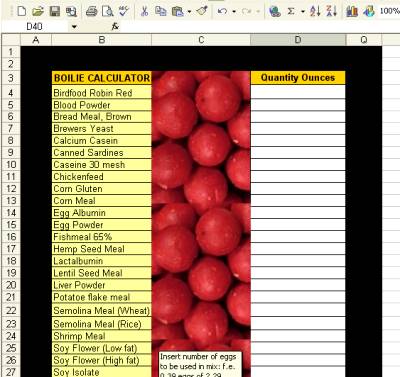
Boilie Calculator (Excel Worksheet)

Boilie Calculator screenshot

Especially for the CAG website, I created a boilie mix composer. With this simple Excel tool, one can easily calculate the composition of a boilie mix in terms of percentages of Carbohydrates, Protein and Fat content. In addition, it’s easy to see what the ultimate hardness of the boilie would be, how easy it is to process the boilie mix and to what extent boilies have a short or long term attractiveness to carp.

Hardness: Scores vary between 25 and 100, with 100 being a very hard boilie that lasts a long time in the water without getting soft

Processing: Scores around 25-50 mean boilies are very difficult to process. The dough may be very sticky, spongy and especially with rolling tables difficult to process. A score of a 100 means you created a boilie makers dream dough composition.

Instant Response: In general, I am assuming that high Carbohydrate boilies lead to a high instant response (with a score between 75 and 100) and would be very useful in short term campaigns without time to pre-bait. High Protein boilies which will score around 50-75, are more useful to be baited up with in the longer run.

So how does it work: Simply fill in the ounces of ingredients that you will be using in the base-mix. There are 30 main boilie ingredients to choose from. For those people who have some specific boilie ingredients they would like to include, please send me a pm or e-mail and I’ll see if I can update the Boilie Calculator.

In addition you have to add the special ingredients such as eggs, sugar, salt, oil, powder additives (f.e. chili powder) and flavors. I used the weight of an “average” egg of 2.29 ounce. Just fill in the number of eggs you will need in your mix in the green cell (in my case I often work with an average of 0.39 eggs per ounce of dry mix, but this will very much depend on the exact composition of the mix). In case you use smaller or bigger eggs, you can manually overwrite the total egg weight in ounces in the blue cell.

And that’s it really. Have a look at it and tell me if you would like something changed. Of course the exact protein/fat/carb content will differ somewhat depending on the supplier and quality of the ingredients. So don’t see it as an exact science. It’s a tool that might give you a better idea of the composition of your boilies, especially for starting boilie makers. Of course you could also apply it for dough balls (with the exception of the “hardness” factor).

If you put the number of eggs at zero, you can also check the composition of any individual ingredient. Let me know if you would happen to disagree with a particular composition. This is still the first version and I’m sure there will be quite a few changes in the future.

Note for the high protein freaks: do you see how difficult it is to get to a very high protein level (f.e. above 60%) if you keep using whole eggs in your boilies? There is simply a too low protein contents in whole eggs. It might be better to start using egg powder and egg albumin instead. Or accept a lower protein contents in the 40-50% ranges (which in my view would be more than enough anyhow).

Have fun!

Carping Basics - Some Necessities

Stuff I never go fishing without ( apart from hooks, weights and bait of course ;o)

A. Binoculars - fish for spotting thereof ( and spying on what other people are up to :)
B. Penknife
C. Good, sharp scissors ( esp. if you use braid )
D. Boilie stops - holds the boilie/bait on the hair rig.
E. Bait needle - for threading baits onto a hair rig.
F. Bait drill - used for making a hole in esp. hard baits ( eg nuts and pellets ) so that they can be put on a hair rig.
G. Superglue. For repairs etc.
H. Gardiner loop tying device - creates perfect small loops on the end of a hair.
I. Forceps - for unhooking fish.
J. Sink tubing - helps prevent tangles and also pins the line down to the bottom so less chance of a fish being spooked by the line.
K. Heat shrink tubing - necesary for many parts of rig creation ( eg boomarms and line aligners )
L. Imitation baits - tougher and bouyant. Shown are imitation corn, maggots and dog biscuit.
M. Rubber bait bands - for attaching small pellets direcrly to a hook.
N. Cork balls - can be used as a bait in their own right, or for moulding paste around.
O. Splicing needle - for threading small baits onto a hair and rig making.
P. Metal putty - for moulding around line to hold down baits and the line itself. More versatile than split shot weights.
Q.Clip swivels - allow you to change rigs and leaders quickly. The leader can just have a loop in one end, which goes into the clip.
R. Float stops - for creating semi-fixed bolt rigs on a running lead setup.
S. Degorgers - for unhooking fish that are deeply hooked.


Hair Rig, Bolt Rig and the Knotless Knot

For 30 plus years I freelined doughballs and swung at twitches...or sat watching the twitches waiting for a good take too swing on...then a few years ago I found the HAIR RIG, thanks to the British, and my whole approach to carping and catch rates changed drastically. Unlike many of my "nice to have", but, "not necessary" Euro items of tackle....this is now a "must" for me..along with baitrunner reels. It can be frustrating when first learning...just like anything else in life....but, with frequent use comes familiarity....and you won't be sorry.

Using a hair rig will greatly increase your catch rate. Carp, for the most part, will usually mouth/taste food first...inhaling it, then quickly exhaling. If they don't like the taste...they won't touch it again. The hair rig will usually catch these finicky eaters on the first taste...especially if coupled with a heavy weight (bolt rig)...which will be covered more later.

The hair rig will also allow you to use harder baits that can't be used on a standard "hook" set up. This has the advantages of being able to cast harder/further and the bait will last longer once cast out. Some of my favorite baits are re-hydrated field corn ($5 for 50 lb bag), chic peas (garbonzo beans), boilies and doughbaits. To use doughbaits on hair rigs...just thread on a small cork or bead on your hair and then you can mold your dough around the cork; thus your hook hook won't be buried in the bait.

Many carpers use a knot to form a loop in the end of their hair. I find this makes too big a hole in the bait you are threading....so I just make the whole hair a loop, as shown in the picture above. Spider Line, 50 lb test is my material of choice for tying hairs...then using a leader material that fits the situation.

To bait a hair, first thread your bait on a baiting needle and hook the hair loop with the needle. The yellow is simulated corn...the red is foam to lift the bait (not the hook) up off the bottom as this will make it more visible and give you better scent attraction in all directions. The foam is not necessary though and could be replaced with another kernel of corn. Another feature of using the foam though is that it can be dipped in a flavor/attractant and further enhance the attractiveness of your bait.

NOTE:You can make a baiting needle by just straightening out a long shanked hook.....slide the bait on the shank...hook the hair's loop with the barb...slide bait onto the hair.

Next...slide your bait from the needle onto the hair.

Then put a hair stop through the loop. I use little plastic bar bells available at craft stores. You can also use a piece of grass or heavy piece of mono line as well. Just something small that will keep the bait from sliding off the loop. Lastly, slide the bait down to the stop. The gap shown between the base of the hook and the bait is about all the bigger you want to have it.

To tie the "hair" itself...view the animated picture below. This is called the knotless knot and in this one you'll notice that to form the loop in the hair...a loop knot was tied. Also...recommend (not shown in animation) that before going through the eye the last time....run the line through your last loop..this makes a half-hitch and "locks" the knot. This is a great way of tying hair rigs if you are going to use the same leader material as you want your hair to be. There are many rig variations in using the hair rig...but, that won't be covered here.

I mentioned the Bolt Rig earlier....If you use a heavier weight ie 2 to 3 oz or even heavier...when the carp feels the hook point upon spitting it out...he'll bolt/flee to get away from it...and the weight of your lead/sinker will set the hook. WARNING: If not using a bait runner reel or some method of allowing line to pay out on the strike...watch your pole closely. :-)) Below is a pic of my typical bolt rig...notice this one is set up for doughbaits...cork is threaded on the hair to mold dough around.

Hope this helped ya some...good carping to you. HAVE A GREAT DAY AND BETTER TOMORROW!!!

Beginning carping


I suspect many of you started out fishing the same way I did. As a kid, I would chase any fish that bit. Yellow perch, bluegill, trout, bass, sucker it didn't matter. The object of the game was to have fun and to catch something, anything really. In time, I got the urge to catch BIG fish. A five pound bass, an 18 inch rainbow, a fat and sassy channel cat, as long as it was bigger than average it put a smile on my face. Unfortunately somewhere along the way, most of us learn to turn our noses up at some fish while prizing others. It's sad really. Why not get excited over a 10 lb carp? Maybe its some rebellious streak, or maybe I'm just an overgrown kid (probably both), but I do still get a thrill catching a big fish, any fish. I especially like fishing for carp, because even average size carp are far bigger than most freshwater species and big carp of twenty or even thirty pounds are not all that rare. I could try to convince each of you of the fighting power of these fish or of their value as a sportfish, but I've found the quickest way to convert a non-carper into an avid carp obsessed maniac is to simply put the rod in the non-believers hands when that first carp rips off with 20 or 30 yrds of line against a smooth drag. That is the purpose of this article: To put a rod in your hands attached to a carp intent on emptying your reel and reaching the other side of the lake! While carp fishing has evolved, mostly overseas, into a very specialized pursuit complete with its own set of specialty tackle, I intend to detail how to catch carp with the gear you most likely already own. If you've got a 5 to 7 ft fishing rod with a spinning, baitcasting, or spin-cast reel spooled with 8 to 12 lb test line, you've got what it takes to catch that first carp. Here is how. Unlike many of the fish we chase, carp are more grazers than out and out predators. Think more along the lines ofa deer than a mountain lion. Sure, they will chase down food in certain circumstances, but more often they are content to efficiently mooch along the bottom separating out food items from inedible sticks and rocks. Assisting carp with this type of feeding are four short barbels used to taste/smell new food items. Additionally carp posess teeth not in the mouth but in the throat which are used to grind up hard food items like mussels,small clams, and various plant materials. Because a carp is virtually surrounded by food, it may be less likely to home in on your bait. Clearly a strategy suited for predators like bass or pike, will probably not be very effective with these foraging carp. To maximize our chances of catching a carp, we need to both find the fish and bring them to us. Finding the fish is a game of its own. For now, keep an eye peeled for any jumping or rolling fish. Also look for bubbles that appear to be moving slowly along. Often carp will stir up the bottom and give their presence away with rising bubbles or even clouds of silt. I've caught carp in water from 1 ft to 30 ft deep. Unless I see carp in an area, I will try to fish on the bottom between 5 and 15 ft deep. Sometimes carp can be found suspended shallow over deep water. I've not had much luck with these, maybe they are just resting. You might try getting up wind and floating several free small peices of white bread over them. Sometimes they will take notice of surface baits. Imagine being able to watch a 20 lb fish swim up and suck in your bait! Carp are creatures of habit. Keep your eyes open and take note of where you see activity. Given similar conditions you are likely to find the carp there again in the future. If you've found the fish and want to keep them in the area, or if there are no signs of fish, but you'd like to attract them try chumming. The best starter chum I can think of is plain old sweet corn from the grocery store. Better yet, buy the gallon size cans from the discount center if you can. It is difficult to chum to much. A single ten pound fish can really hover up the bait in a hurry. Just imagine how fast a whole shoal of fish can eat. Getting the corn out the fishing area requires creativity. Tossing by hand, using a sling shot, lashing a throwing scoop to the end of a broom stick, all are at least partially effective. Swimming, boating, or float tubing are also good ways to get the bait out. Chumming both attracts the fish and creates a competitive feeding situation, like tossing seed to pigeons. Carp competing with each other are less cautious and more easily caught. Ok, let's say you've found a likely spot and chummed it up a bit. Now you are ready to rig up and bait up. The key to remember here, is that a small rig can always catch a big fish, but a big rig is not likely to catch small or even medium sized fish. Despite their large size, carp have relatively small mouths and tend to feed on small food items like baby clams, seeds, insects and the like. So, lets start off using a hook anywhere from size 4 through 8. Since a carp bite will likely be much softer than say a slashing bass, extra sharp hooks are required. The Eagle Claw lazer sharp baitholders are a step in the right direction. For bait, I strongly recommend canned corn. Right out of the can or flavored with anything from sugar and kool-aide to peppermint shcnapps, sweet corn is an almost magical carp bait. Other baits to try include soft doughbaits, worms, and bread. Due to the suck and blow feeding pattern of many carp, I have the most confidence in an exposed hook point.
Rig-wise, carp can be very sensitive to resistance. For this reason, I recommend using a sliding casting sinker of 1/4 to 1/2 ounce like that pictured in the diagram. With a sliding rig and light bite indicator (discussed below) you should be able to see the carp bite before the carp notices the resistance and spits out the bait.
Carp fishing can be a waiting game. It really pays to fashion some sort of rod holder. The traditional forked stick can work well with one modification. Insead of propping the rod tip in the air, try placing two forked sticks in the ground about 3 ft apart. Then position the rod horizontally across the two sticks (see rod set up diagram). Position the sticks so that the rod points directly at the bait. Once you have cast out and placed the rod on the sticks, slowly reel as much slack as you can out of the line. Pull a little bit of slack from the reel, and hang a light bite indicator on the line between the first and second rod guides. Finally back the drag way off so that a running fish can't pull your rod in the water before you have a chance to grab it.
Here is a diagram on how to construct a simple, light weight bite indicator from a small bobber and a snap swivel.
When a carp begins to play with your bait, you will be alerted by the bite indicator starting to jiggle, fall, or rise. This is the moment you have been waiting for! When the dance turns into a slow steady pull or drop take up the slack, secure the spool, and set the hook. Remember to slowly re-apply the drag or you will soon find you are out of line! A carp's first run can truly be a knee wobbling experience. Just keep up the pressure and the fish will eventually turn, maybe. Don't try to horse the fish in. Fish this large require a lift up and wind down strategy. When the fish is not running, slowly lift the rod tip, then slowly wind in the line gained while gently dipping the rod tip lower and keeping a tight line, repeat, until the fish tires and is played in close to the shore. A long handled net is a real fish saver since there is no way you can lift a fish of this size with the rod. If you happen to have one, I'd recommend using the rubber meshed boat nets like those used for walleye or pike as they will cause less damage to the fish and they are tough enough to flex deep and envelope your newest trophy capture. Consider carp like bonefish or tarpon, while a blast to catch they do not have to be eaten. Small carp from clean waters are very good when properly prepared, though. If you do plan on releasing your newest capture, please consider holding the fish horizontally as depicted on the Carp Anglers Group Logo displayed below. Lipping, gilling, eyeballing, or gaffing these heavy fighting machines can easily damage them. A fish friendly and accurate way to wiegh your prize is to keep the fish in the net. Then hook the scale onto the net rather than directly into the fish. You can later subtract the wieght of the net from the total to yeild the fish's weight, or not... Well, I hope you are now on your way to targeting and catching your first carp on rod and reel. If you happen to contract carp fever, please don't hold that against me. Carp fishing can become a true addiction. But don't worry, you are not alone.

Wednesday, 12 September 2007

Float Fishing For Carp


It was said that a float is one of the few things that is more pleasing in its disappearance than its appearance ! Using a float is one of the most efficient and sensitive methods for fishing for carp.With a float you get a real feel for what is going on under water. The slightest knock is recorded sending your heart racing. Choosing the right float for the job is most important. Where i am at the moment you cant seem to get hold of light weight floats very easily. In fact the ones i have seen are about as sensitive as a baseball bat ! In the uk there are lots of nice floats available but i tend to make my own out of peacock and porcupine quills I have several "lucky" floats which i always use :-) The Floats i use have one thing in common , they are of a slim design with small sensitive tips.They normally take between 2 BB shot and 2 AA to sink them. The method i use most of the time is "laying on"or the "lift method". This involves attaching the float to the line with silicon rubber bands so it is tight on the line but is free to move with some effort Its important that you have no weight near the float. You tie a hook on the line (with or without hair rig) You deliberately set the depth(by sliding the float) well under the (approx) depth of the water. You then add enough weight so the float just sinks! You move all the weights to about six inches away from the hook. You then keep increasing the depth by sliding the float up until the float no longer sinks but has about 1 inch out of the water. This means the weight (2 BB) are exactly on the bottom. With the last six inches of line with the hook along the bottom. When you get a bite the float will rise upwards !

This is because when the carp sucks in the bait he lifts the weights so the float is not counterbalanced (simple physics) The beauty of this method is that the carp feels no weight or resistance as the float helps to lift the weight. Also its easy to tell between a line bite (knock) and a real bite (lift) This method is superb on stillwater and lakes but is difficult to set up on fast moving rivers. Float fishing is fun but can be hard work and is restricted to close range fishing .


Tackle Needed


The type of rod needed is a through action rod of between 1.5 and 2 pound test curve. You need a rod that has a nice action to flick a light weight float out to at least 20 yds.If i am float fishing i normally only use 8 pound breaking strain line. If i think the carp are very cautious or i need to fish a heavier line (fishing near snags)I will substitute the last six inches of line for braided type line (Rod Hutchinsons "The EDGE") .I feel that the braided lines are a lot softer than 15 pound mono .Also its worth noting that many of the braids on the market float! The Edge sits along the bottom nicely so is my first choice . The line and the braid are joined by a small swivel. This acts as part of the weight so you dont need to add as many weights to the line . You can float fish using boilies and hard particles by adding a hair to the hook .

Surface Fishing For Carp


One of my favorite ways of fishing for carp is to catch them "off the top". This means to catch carp using floating baits on the surface film of the water.

Baits


The types of baits you can use are endless but of course they must float. Breakfast serials such as sugar puffs ect , work quite well but have the disadvantage of being light so you cant catapult them very far ( especially on a windy day !) The most popular bait and probably one of the best is bread. This is a good option when there are no small fish around as they will peck the bread off the hook in no time at all. Sometimes stealth is needed to get a large carp so if you are always recasting to replace the bread this will spook the fish. Another option is "floater cake" . This is a boilie mix with baking soda added to make a sponge like cake. By adjusting the consistency you can make it quite hard but will still be buoyant. By far the best type of bait to use are various pet foods (purina , pedigree chum ect ) Before buying a large sack check the size of the pellets and that they do float.

Techniques


The problem with these types of baits is they are rock hard so how do you put them on the hook. What you need is a knife and some superglue (carp anglers friend !) . You cut a groove in the dog buscuit just deep enough so the shank of the hook will lie in it then superglue the hook to the buscuit. It takes about five minutes to dry but will stay on for at least 30 mins in the water. Some friends of mine have had a lot of success replacing the dog buscuit on the hook with a piece of cork or balsa wood cut to shape. Even with the weight of the hook and bait this is still not enough to cast very far so you have to add weight to the line in the form of a controller. This is a weighted float (bobber) which lets the line run along the top of the water.

At long range this can act as an indicator when its difficult to see the bait Its best to have the controller set at least five foot (1.5 metres) from the hook to avoid spooking the fish . Sometimes the fish might even be out of the controllers casting range so we can add a lead to the line and fish a sliding controller set-up as follows

If carp in a water have been caught on the standard floater setups quite a bit they can become wary of the line attached to the hook lying across the water.In this case we can use the "Beachcaster set-up" as follows

As you can see from the diagram no line touches the water so its very difficult for the carp to spot the hookbait from the free offerings. In the UK some waters have banned this method as it is too good !


Approach


The best way to approach floater fishing is to build the fishes confidence by not casting in too soon. You must keep introducing free offerings till you get the fish feeding confidently that they wont mind you casting a controller out. Also this encourages other carp to join in .Its not easy to hold back and wait while the fish are feeding but this means that you can try and select a bigger carp. For if you hook a carp in amongst feeding fish there is a great explosion as all the fish are scared off . It may take a while to get the fishes confidence back so you dont want to waste the chance on a smaller fish. Sometimes it may seem that some people are lucky in the size of fish they catch. With this technique you can be more selective about the size of fish you catch . I tend to pull the bait away from the mouth of a fish if i think its a smaller one. This tends to spook the fish (but only a little if you do it slowly !).This is why you need to get the fish confident so you are always in control of the situation. With floater fishing it is best to watch the bait rather than the controller as you will be able to strike quicker. At range if you cant see the bait always try and wait for the line to move before you strike as you dont want to spook the fish for no reason . You may get a lot of swirling around the hookbait if the fish are not very confident . You must have nerves of steel and the patience of a saint to avoid striking before you get a "real" take. That moment of excitement is well worth waiting for !

Tackle Needed


The sort of tackle needed for floater fishing depends on the situation but i would tend to go for a 11-12ft through action rod of about 2 pound test curve. You need a rod that will cushion the initial take from the fish . The first run can be stunning in its speed and power.The line size depends on surrounding conditions. If there are lots of trees and snags in the water nearby, you may need to bully the fish away from these so 12-15 breaking strain would be about right Try to use a line with lots of stretch as this will adsorb a lot of the power of the fish. If conditions allow use a lighter breaking strain , especially for the hooklength as this is less likely to turn the carp away. Hook size and pattern are important , dont go any larger than a size six , as anything else will be too heavy for your floating buscuit plus the carp may be able to see and feel it and spit the bait out. The pattern i use are Drennan Super specialist size six or eight . Dont be frightened to use small hooks as they have a smaller gape and are really strong. None of the fish on my web page were caught with anything larger than a size six .You can use a standard reel as long as it has a good drag (clutch). The Controller can be made out of pike floats or you can use a bubble float half filled with water to add casting weight without sinking.

Floater Fishing Conclusions


Floater fishing for carp in the UK is very strange in that some waters are "floater waters" and others are not . This means that at some waters the carp are not very responsive to floating baits where others they get caught all the time. I believe its possible to catch carp off the top at most waters but at some its very hard to be consistent. Some anglers in the UK use floater fishing method to exception of all others.There is no doubt that floater fishing is one of the most exciting ways of catching carp . There is nothing like the excitement of watching a big carp approach your bait . Floater fishing can be considered as another method that can be used when the situation arises. Floater fishing can turn a bad day into a good day.

Winter Carp Bait Secrets


1. Wheatgerm in carp baits:

Many fisherman hook more fish on baits made with wheatgerm in the winter, but why is this?

Commercial aquaculture feeds often contain wheat germ at about 10 % of the dry feed mix to provide more easily digestible energy in cold water temperatures. Winter, colder water formulas often have a reduced protein content of fish meal for example, but with the addition of wheatgerm.

Wheatgerm has been proven in scientific tests to have a role in dietary fat and cholesterol assimilation: plasma lipids and cholesterol were significantly decreased by addition of these two wheat components in diets of rats. Many substances that reduce harmful cholesterol in a carp’s body can be put into bait, are very healthy, and are very attractive to carp as a result. These act to keep the liver and circulation healthy, among many other helpful roles.

A word about ‘bad’ cholesterol or ‘saturated fatty acids.’ In the correct ratio with, for example, monounsaturated and polyunsaturated fatty acids, these are helpful in the carp’s body for energy production. They are broken down by enzymes (globular proteins), in successive two-carbon fragments called ‘acetates’. These then oxidise in the cells to produce energy, which is used or stored using adenosine triphosphate.

Cod liver oil is a great carp bait additive. It contains a profile very much like the famous carp attractor fenugreek ‘extract.’ it contains a volatile oil, and two or more ‘alkaloids.’

Many alkaloids are especially powerful carp attractors and many can be used for effective homemade fishing baits for many species. Trigonelline and choline in the cod liver oil accelerate the release of energy from the carp’s liver, and reduce glycogen deposition.

Fish seem to really enjoy these effects, and getting caught on bait containing these substances! (Cod liver oil is one of the richest sources of vitamins A and D in the world too!)

2. Lecithins:

In winter, it is recommended to drop oil levels slightly in your baits, and add an emulsifying lecithin. These make your oils into a water-soluble emulsion, making it much easier, very importantly, for the carp to digest your bait more effectively for energy.

Lecithins are very interesting ingredients. The newer ‘enzymatically hydrolyzed’ ones have the best properties, including certain extra activity on other ingredients:

* Higher ‘surface’ activity.

* Better emulsifying properties.

* Excellent emulsion stability, ('oil-in water dispensability.')

* Ability to interact with starch.

* Different kinds of interactions with proteins.

* Lecithins are derived from vegetable oil seeds, soya bean oil, and egg yolks.

They contain choline (a ‘pre-cursor’ to betaine which assists natural lecithin production in the carp, reduces cholesterol levels in the liver, and is a major source of the essential amino acid in the carp, methionine) fats, inositol (essential at the cellular level for good functioning, especially in the intestine for digestion), and essential fatty acids.

Lecithins and wheatgerm are just 2 ingredients that can make all the difference, to produce great winter carp fishing results. It truly pays to discover as many bait edges as you can, for this colder season!

How To Make Easy Catfish And Carp Baits - Simple Cool Ingredients For Instant Catches!


I’m always messing about with baits it’s so creative and fun. I even make my own flapjacks too! Making instant carp and catfish baits that really work can be very easy and simple without the need for too much technical know-how! Fishermen go on about ‘nutritional attraction baits’ versus ‘flavoured attractor baits’ versus ‘fake and plastic baits’ and so on and the difference in the prices of these baits can be enormous. But who cares what you use as long as it’s safe, does the fish no harm and really catches you fish! Here’s a few ‘alternative’ tit-bits on making baits that will catch you fish.

Your local stores can provide all you need but you can use specialist fishing additives and attractor ingredients too. Very easy baits for carp and catfish of many species and sub-species often utilise the same ingredients to stimulate the fish which makes things simple.

(You can make yourself some flapjacks, brownies or cinnamon scones while you’re at it if so inclined, all the ingredients you need for these are eggs, self raising flour, sugar, salt, margarine and a raising agent like bicarbonate of soda.) Making these things is a great fun way to practice making good palatable baits for starters! As a side note, have you noticed how addictive ‘Marmite’ or ‘Vegemite’ (yeast extract spread) on toast with lashings of butter’ is? Unfortunately it makes your feel dehydrated and maybe keen to have a drink, preferably a caffeine, milk and sugar containing coffee or tea to wash it down?

This is just to remind you how easy it is to get our body and mind in a particular state just by eating a simple snack or a ‘simple’ beverage. In fact these foods and drinks are popular because they are literally addictive. Once you’ve been having these for long enough, giving them up is something your body and mind can have trouble with and even give you withdrawal symptoms!

From the monosodium glutamate and salt in the ‘Marmite,’ to the opiates in the wheat flour, butter and milk, these foods have strong impacts on your body and mind. Even the fat in the butter and milk, the powerful effects of the caffeine in the beverages and even the sugar and its powerful taste enhancing effects leave you wanting more...

You really want your catfish and carp baits to be like this and it is easily achievable, especially by exploiting the high-tech refined specialist bait ingredients available today. However much more simple baits can offer a level of this effect too using ingredients from your average kitchen.

You can make a wide range of successful baits by using soya powder or meal and semolina as the basic dry powder mixture, but corn flour and wheat flour can be used too as base ingredients to make paste or dough baits or even boilies, but be sure to use ‘plain flour’ rather than the ‘self-raising’ types. Your base mix powder may not be very ‘nutritionally attractive’ at this point but this is easily remedied as you will see... Your baits do not have to be high protein wonder baits to catch big fish. Even these marvels can ‘blow’ and become less effective after fish have been caught on them enough times. In fact very simple carbohydrate type baits with a couple of added special ingredients to effect the fish in powerful ways are often enough to tempt the biggest fish. But you need to know what ingredients affect fish the way you want...

Can you imagine what adding an alcohol flavour does to you bait and how it affects the fish? What about garlic; what’s really going on there? Why is liver and blood so effective? What about the effects of betaine, green lip mussel extract, or honey, molasses or brown sugar? Knowing about these type of effects on the fish might seem irrelevant, or are they?

For pastes or dough baits, just add water, or eggs to help binding and bait durability. The usual number of eggs used per pound of dry mixture is 4 per pound of dry mix to 6 per kilogram of dry mix. Added eggs will enable you to make skinned steamed or boiled baits too if preferred.

Baits with added eggs will have a higher protein level than those with water and when rolled into balls can be boiled in water or steamed in a pan to make them form a resistant coagulated skin which makes the baits last longer. You will discover that experimentation is the key to making baits and recording the amounts and ingredients you use will really pay you back especially when you want to re-make that ‘bagging bait’ and have forgotten what it contained!

You can do a short-cut by buying prepared cooking pastry mix. This is attractive because of its sugar salt, fat and wheat content, all of which can be pretty addictive and it can work well on carp, but needs more ingredients to get the catfish biting. You can make it that much better by rolling it out and liberally spreading peanut butter and yeast extract, like ‘Marmite’ or ‘Vegemite’ onto it, but the list you can add is endless. Liquidized chicken liver or pork liver are classic examples as are shad guts and chicken blood from a friendly butcher. However, Blood powder, liver powder and squid powder, fermented shrimp powder, shrimp and krill meal,

It may sound simplistic, but for example, yeast extract contains lots of attractive salts with those used in its production, enzymes, such as trypsin (the protein digesting enzyme,) soluble proteins, amino acids, peptides, minerals, trace elements, vitamins like B6 and B12, carnitine, chitin, yeast extract is also a major source of the infamous food enhancer monosodium glutamate for the food industry. It is also water-attracting being hygroscopic (like honey and malt extract and peptones interestingly,) and is highly soluble a digestible. Peanut butter has much going for it too including sugar, salt, high fat content, tasty oils and great palatability and even its own highly fish attractive enzymes. There are very good reasons why even the ‘simplest’ kitchen ingredient works.

The attractiveness of peanuts and peanut products is so well known, but fewer fishermen realise that crushed peanuts make great ground bait and cook-up well absorbing all kinds of added attractors like sugars, salts, flavours, spices, essential oils, colours and so on. Peanut oil is another great attractor too, while de-fatted roasted peanut meals can have a protein content above that of many fishmeals and are very well consistently proven fish catchers.

Getting back to your easy simple bait, a generous amount of molasses or brown sugar will really help. Many fishes love sweet smells and tastes and a quick energy ‘hit’ from the sugars is appreciated too. In fact ‘polysaccharides’ play a big part in wild fishes natural diet and are derived from ingesting mussels and shrimps and other shelled organisms.

It’s a good idea to add a bit of protein to your simple flours baits. Fish can are very drawn to attractive proteins, amino acids, polypeptides and this has been consistently proven with catfish and carp etc. In fact, often the baits meant for carp or catfish end up catching other big specimens of other species including bass, big pike and tench, pickerels, eels and so on. Adding liver powder or mashed-up tinned fish, ground trout pellet powder, or any of a range of fish meals and meat meals, shellfish meals and milk powders will all make a big difference to your simple bait’s effectiveness. You can even add ground-up sinking pond pellets if you want to really ensure your fish get a guaranteed ‘balanced meal’ if you’re so inclined.

You could mix in large amounts of flaked cold-water fish food which is a very effective edge in making a very ‘alternative’ bait. These are high in things like spirulina, carotenes, complex sugars and daphnia. (All good stuff.) Incorporating casein and whey protein body-building powders into your simple flour or pastry mix really is an edge adding much recommended ‘free amino acids’ among a huge list of other beneficial attractors.

Many fishermen feel they need a boost of extra confidence by adding a flavour to their bait. While there are a handful of ‘giants’ than really shine through in the world of fishing flavours, just a few drops of butyric acid will do the trick. Even adding fresh juice from red or blue fruits like strawberry, mulberry, blueberry, acai berry etc adds great flavour and very powerful fish attracting acids, enzymes, flavours, sugars etc.

Even adding flavours at levels we cannot detect ourselves will work. E.g. half a teaspoonful per kilogram of bait. It is also a fact that many baits have proven to work without any added flavours at all. The best flavours are probably better called ‘fish detection tools’ or even ‘fish mood and activity changers.’ This is a far cry from the simple cake flavours many beginners start off using. The proven catches difference between using a simple alcohol based vanilla flavour compared to a fishing bait proprietary brand flavour proven for decades like ‘Scopex’ or ‘Tutti Fruitti’ or ‘Monster crab’ is gigantic.

Experiment kneading the mixture together into a dough. Until you have a practical bait and put into marked and dated bags, but many of these baits can quickly be made on the bank or boat which is really useful. Baits can be round shapes, square, triangles, pellets or just random shapes. You can use these baits fresh or store them temporarily in the fridge or freeze them. By noting what ingredients you add and the amounts used you will be able to make any bait in the future and associate with it any interesting results apart from personal best captures. Just putting bait into the margins where fish can browse on your baits is a very valuable thing to do to help assess their response.

Personally I’d do this with any batch of bait before bothering to fish. Watching fish feeding on your bait is fantastic. (And often the biggest fish are caught on a new bait they have never experienced before.) Testing different batches of bait like this will certainly show you the winners and dramatically increase your confidence in your new baits. You will find that some of your homemade baits will out-perform those expensive shop-bought baits and by making your own baits you will learn practical ways to enhance or alter those shop baits that are ‘in’ too in order to ‘top’ them. Although there is far more to making and enhancing baits this will get you on your way!